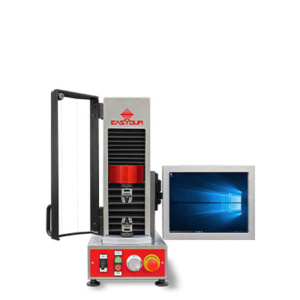
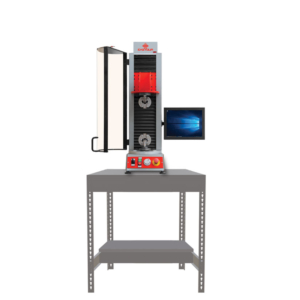
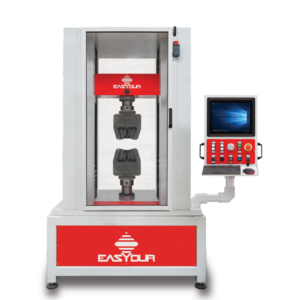
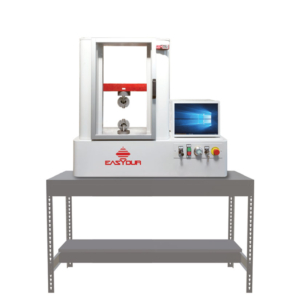
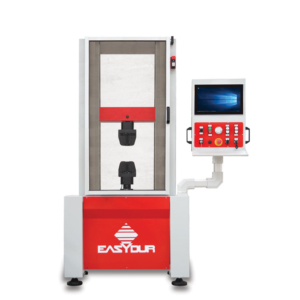
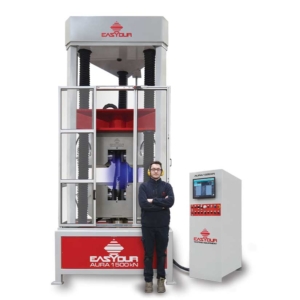
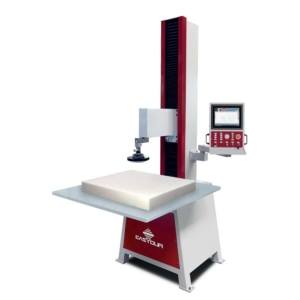
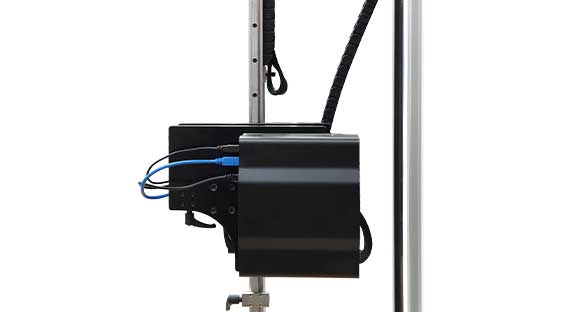
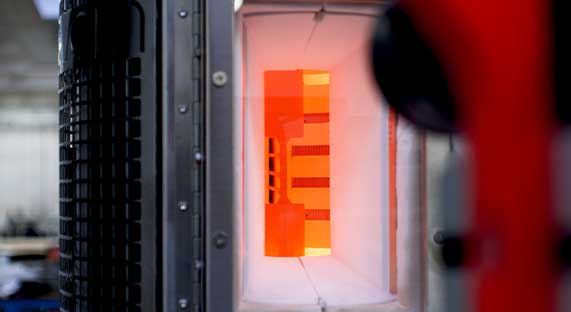
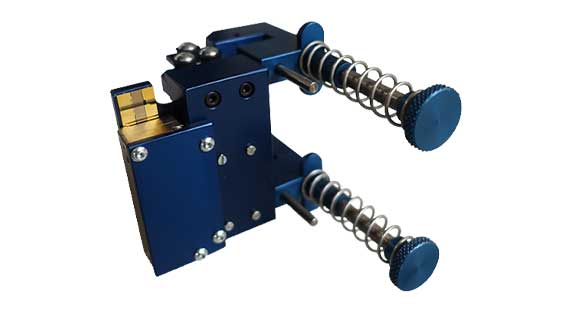
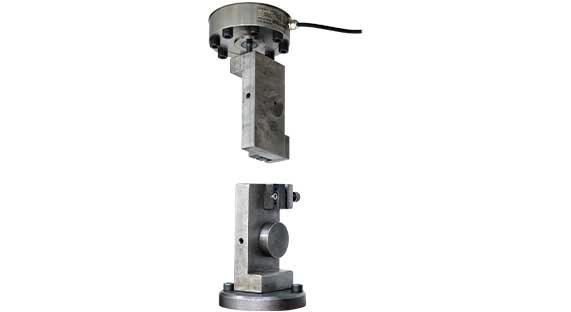
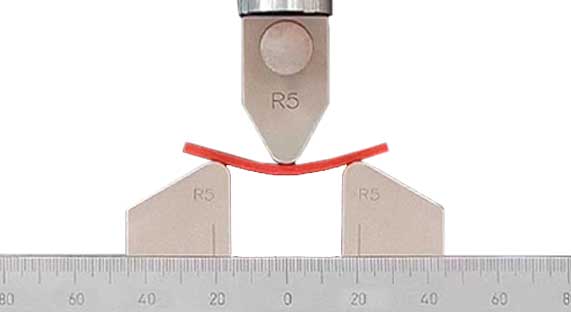
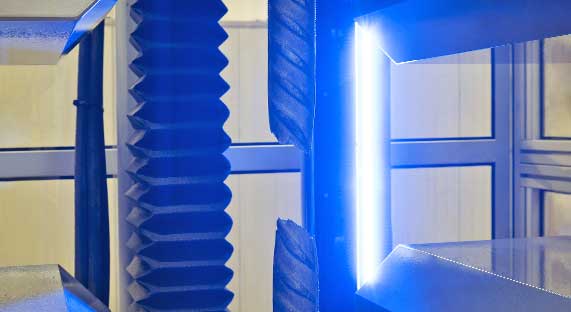
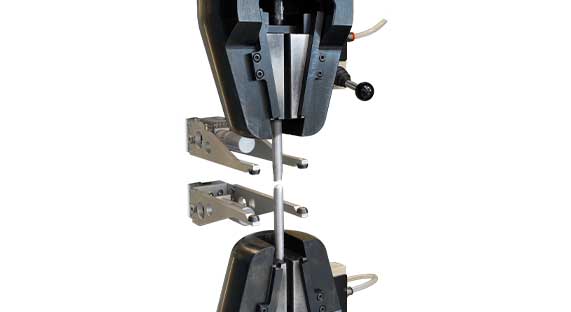
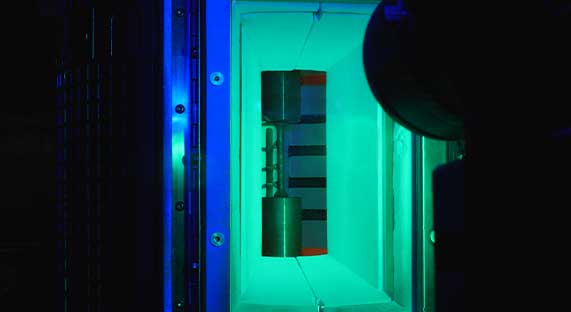
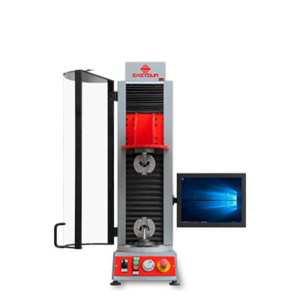
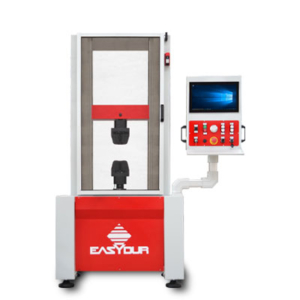
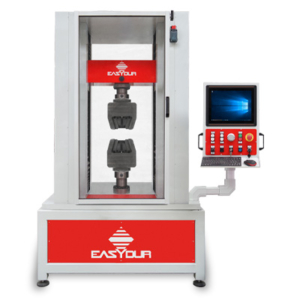
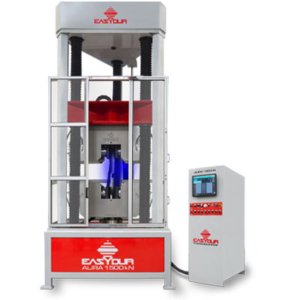
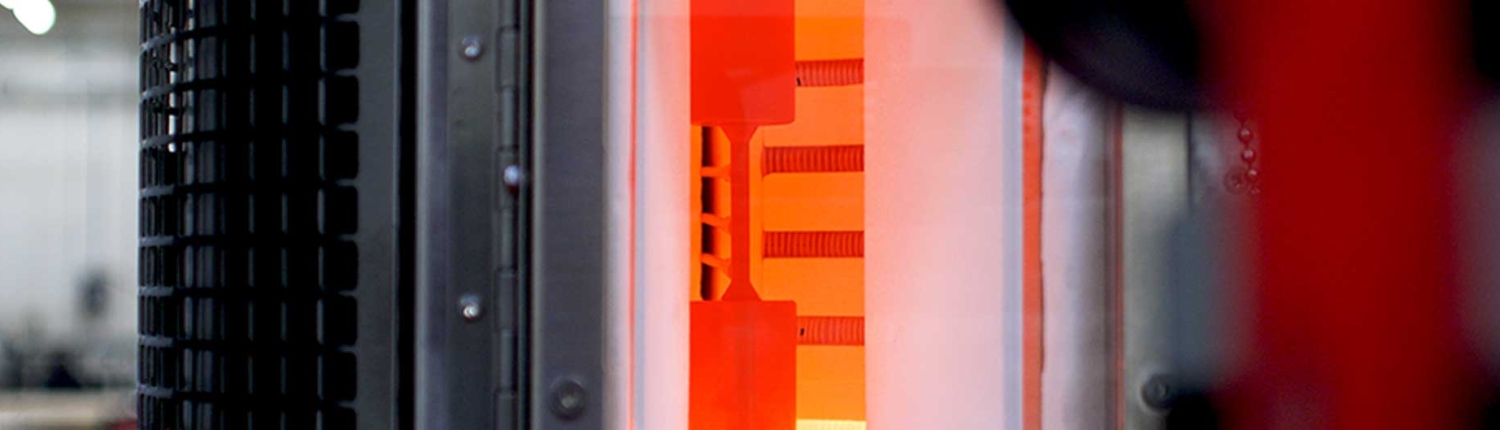
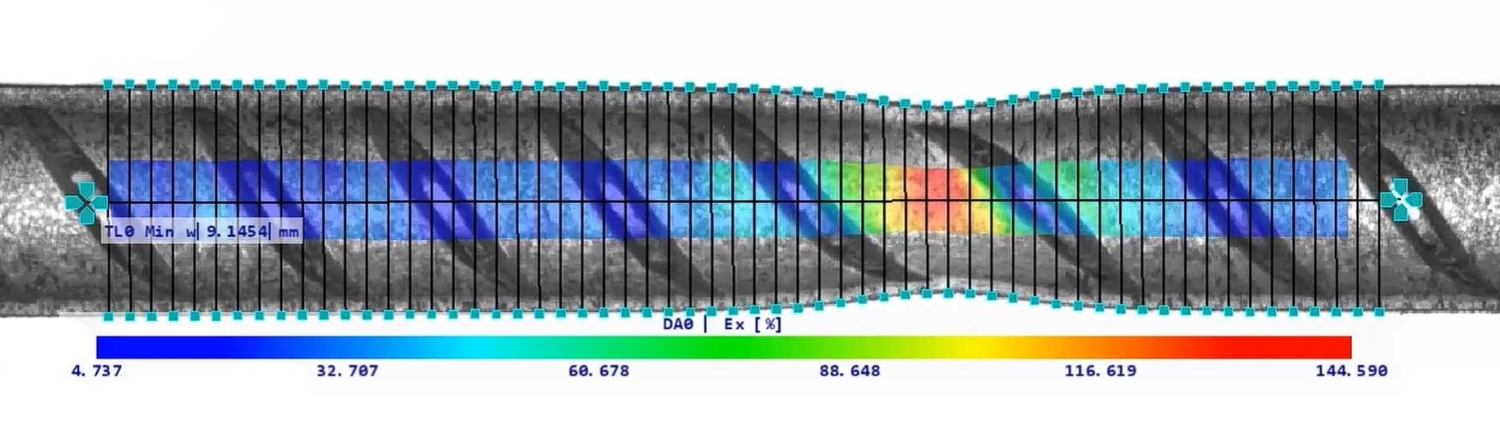
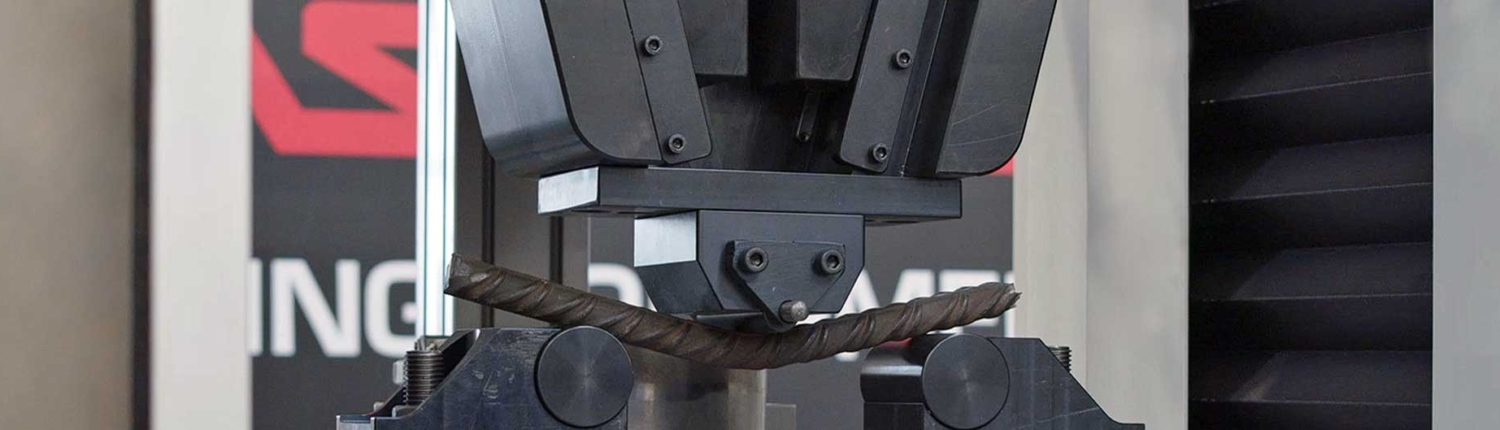
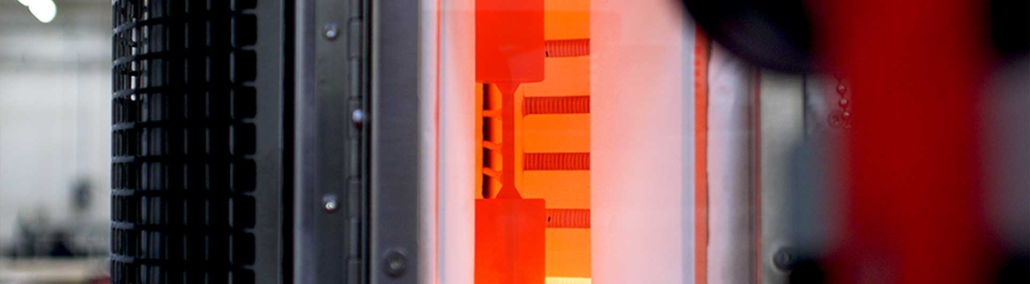
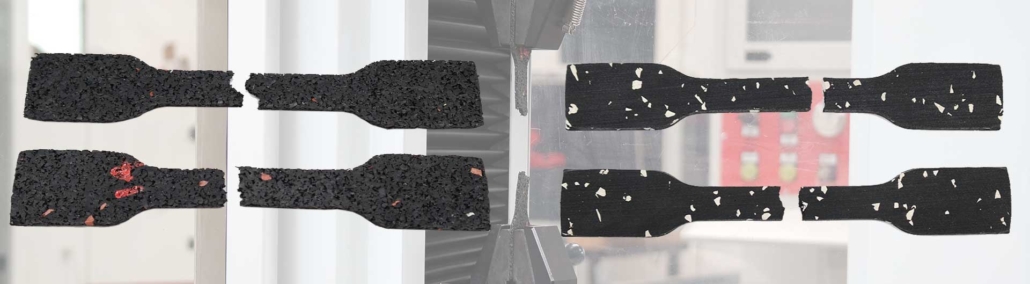
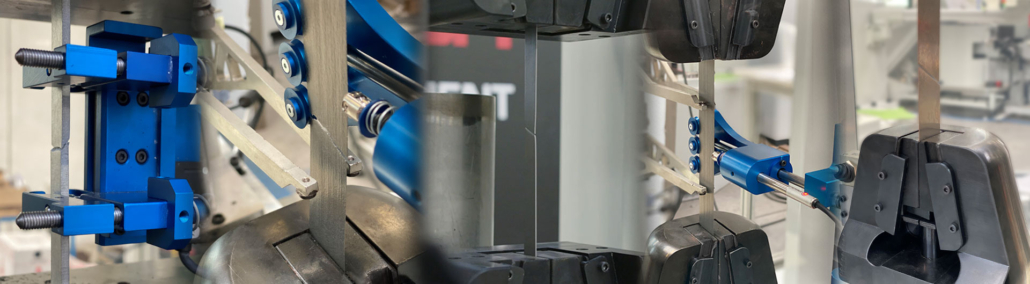
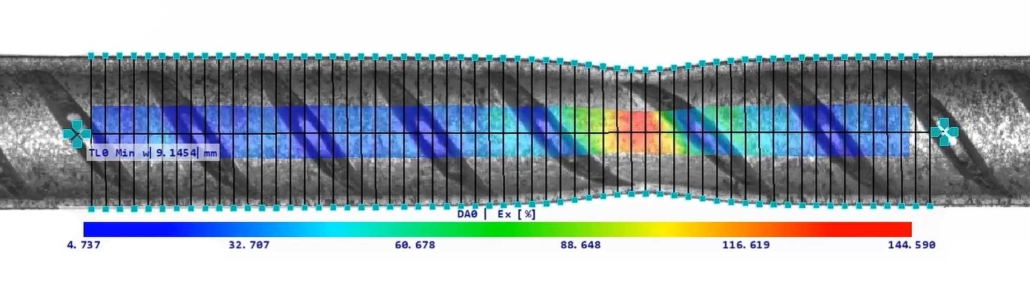
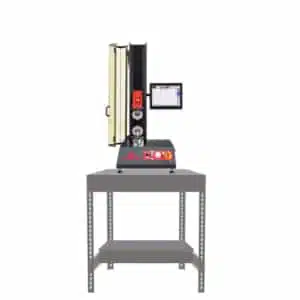
Aura Universal Testing Machines series operate with computerized numerical control and includes a computer with HDD and touch screen. It is a self-supporting, two-column structure with ball screws able to reach loads up to 200 Ton. Its electronic setup enables cycles of stress of sinusoidal form resulting in machine preservation and remarkable performance. Aura is the biggest of our Universal Testing Systems and is DC power driven, with encoder (or optical ruler). Aura Universal Testing Machines can be equipped with various kind of extensometers, both contact/mechanical, as well as contactless (video extensometers). Some of the standards for tensile tests: ASTM B557, ASTM E190, ASTM E21, ASTM E290, ASTM E446, ASTM E517.
HOW IS THE TENSILE TEST PERFORMED?
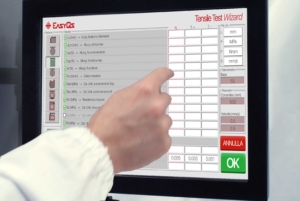
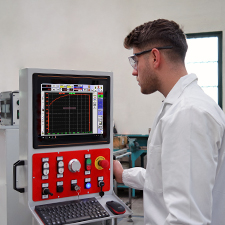
Thanks to the great ease of use of Easydur universal testing machines, performing a standardised tensile test is truly simple and intuitive. Just a few settings, and it will be possible to immediately launch the test and start collecting all the data for the characterisation of the desired material or product.
Thanks to EasyQs Wizard, it is possible to perform all kinds of tests according to international standards (for example ISO 37, ASTM D638, ASTM D882, ISO 178, ASTM E290, ASTM B348, ISO 3266, ISO 6892, ASTM E21).
The main tensile test steps are as follows:
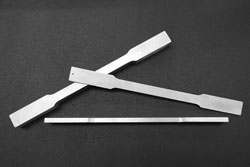
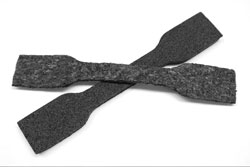
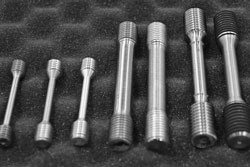
- Preparation of the specimen type for the standardised tensile test (according to ISO, ASTM)
- Test selection or recipe creation using the EasyQs universal testing software
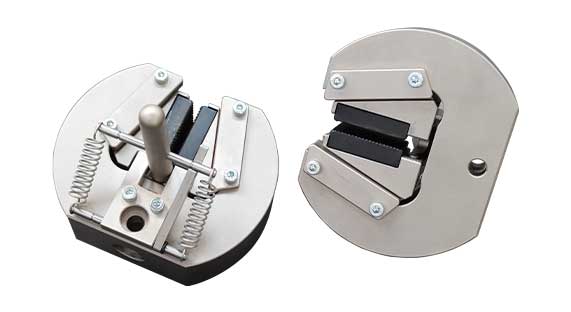
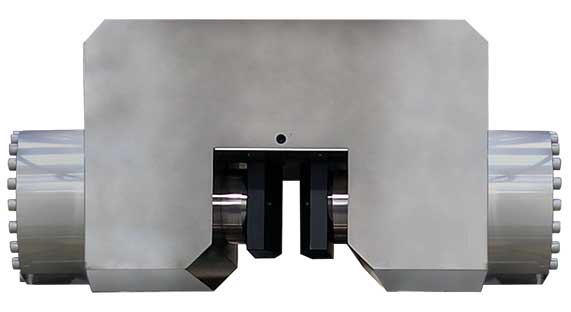
- Fast and safe placing of the specimen in the mechanical, pneumatic or hydraulic grippers.
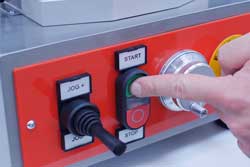
- All that is needed now is to press “start, and the test will be launched and completed automatically
ACCESSORIES FOR UNIVERSAL TESTING MACHINES
Contact us and show us all your customization needs!
Universal Testing Machines: frequently asked questions
How to calculate Ultimate Tensile Strength (UTS)
The breaking load of a given material (also known as Ultimate Tensile Strength, or UTS) represents the maximum stress level applied to a specimen during a tensile test. When a material is subjected to a specific force, generally through the use of a Universal Testing Machine, the resulting molecular-level deformation is generally counterbalanced by internal stresses; however, this physical phenomenon has a limit, beyond which failure occurs. It should be noted that this parameter does not necessarily correspond to the specific force at which the sample actually breaks, as factors such as environmental conditions, the use of materials with varying degrees of strength or ductility, and specific material characteristics can lead to unique behaviors. Information regarding the breaking load can be obtained by examining the graphs and data provided by the testing machine, thereby allowing for an assessment of the material's ultimate strength.
What does Hooke's law state?
Hooke's Law states that the stress-to-strain ratio yields a constant value, as a linear relationship between the tensile force and the sample's elongation can be observed during the initial phase of a tensile test on so-called elastic (or linear-elastic) materials. It goes without saying that this is an approximation – albeit a widely used one – that finds extensive application in both material science and the engineering and manufacturing of springs (for instance, in the experimental determination of a spring's elastic constant through the use of testing machines).
Which are the most common norms for compression tests?
• ASTM D575: Standard test method for rubber properties in compression • ASTM D6641: Compressive properties of polymer matrix composite materials using a combined loading compression (CLC) test fixture • ASTM D695: Method for determining the compressive properties of rigid plastics • ASTM D905: Standard for measuring the strength properties of adhesive bonds in shear by compression loading • ASTM E9: Compression testing of metallic materials (room temperature) • ISO 14126: Determination of compressive properties in the in-plane direction of fibre-reinforced plastic composite materials • ISO 1856: Compression of flexible cellular polymeric materials • ISO 604: Determination of compressive properties of plastics • ISO 844: Determination of compressive properties of rigid cellular plastics • ASTM C109: Compression test on concrete cubes • ASTM C39: Compression test on concrete cylinders • ASTM D1621: Determination of compressive properties of rigid cellular plastic • ASTM D3410: Measurement of compressive strength of polymer matrix composites • ASTM D6484: Open-hole compressive strength of polymer matrix composite laminates • ASTM F1306: Low-speed puncture resistance test of flexible barrier films and laminates • ASTM D3574: Standard test methods for flexible cellular materials
What does Young's modulus indicate? How do you calculate the modulus of elasticity?
Young's modulus (or the modulus of elasticity) expresses the relationship between stress and strain under uniaxial loading conditions, and is measured with specific accessories (extensometers) equipped on tensile testing machines. Among the three main elastic moduli – tensile, compressive, and shear – Young's modulus represents the ratio between tensile stress and the corresponding relative elongation of a material. As an example, consider a bar with a constant square cross-section that, ideally, exhibits identical properties in every direction. If a tensile force is applied to this specimen, every point within it is subjected to a stress that varies proportionally with the applied load. As a result, the fibers aligned with the direction of the tensile force elongate, while those oriented perpendicular to the applied force contract. Young's modulus (expressed in N/m² (Pa) or N/mm²) is the longitudinal modulus of elasticity, obtained as the ratio between the applied stress and the resulting strain, whereas the lateral contraction is described by Poisson's ratio. Young's modulus is highly sensitive to temperature variations in the tested specimens, since both the equilibrium spacing between atoms and the interatomic bonding forces are affected. For metals, for example, Young's modulus decreases as temperature increases. In the construction industry, Young's modulus is widely used to determine the mechanical properties of materials such as concrete. In this context, the compressive modulus of elasticity is commonly considered (again, based on empirical equations). In any case, the compressive modulus of elasticity is defined according to UNI 6556.
Universal Testing Machines: how do they work?
A Universal Testing Machine (UTM) is a versatile mechanical testing system used to measure the mechanical properties of materials by applying controlled tensile, compressive, bending, shear, or other types of loads. Thanks to interchangeable fixtures and accessories, a single machine can perform a wide range of standardized tests on metals, plastics, composites, rubber, textiles, adhesives, concrete, and many other materials.
A UTM operates by applying a controlled force or displacement to a test specimen while continuously measuring the resulting load and deformation. The main components include a rigid load frame, a moving crosshead driven by an electromechanical or hydraulic actuator, a load cell for force measurement, and extensometers or other sensors for accurately measuring strain or displacement.
During a test, the specimen is securely clamped or positioned using the appropriate fixtures. The crosshead moves at a predefined speed or load rate according to the selected test standard, while the machine records force, displacement, and, when required, strain. The acquired data are used to generate stress-strain curves and calculate key mechanical properties such as:
• Tensile strength
• Compressive strength
• Yield strength
• Young's modulus
• Elongation at break
• Flexural strength and modulus
• Shear strength
• Peel and adhesion strength
Modern universal testing machines are controlled by dedicated software that automates test execution, data acquisition, analysis, and report generation. Most systems comply with international testing standards such as ASTM, ISO, EN, and DIN, ensuring repeatable and reliable results across different industries.
Because of their flexibility, universal testing machines are widely used in quality control laboratories, research and development, production facilities, and academic institutions to evaluate material performance, verify product compliance, and support product development.
Material testing machines: which tests, and which materials?
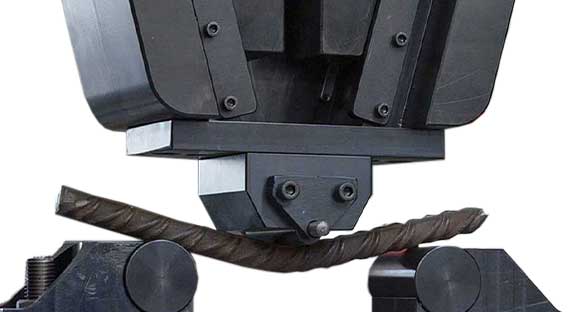
First, let's clearly define the term "material testing machines." In most cases, these are static axial testing machines, meaning they perform tests along a vertical axis, either in tension or compression. Therefore, to answer the question "Which tests can they perform?", a good rule of thumb is that any test involving pulling or compressing a specimen can be carried out using Easydur material testing machines. Whether it is a tensile, compression, or flexural test, or a non-standard test developed for specific applications—such as research and development—the key characteristic remains the same: these are all axial tests. But what do we mean by "static" (or "quasi-static") testing? These are tests performed using non-dynamic material testing machines, where the test cycle consists of a single stroke (upward or downward) until a predefined displacement, a specified load, or specimen failure is reached (as in tensile testing). Static material testing machines are characterized by relatively low testing speeds—typically up to approximately 500 mm/min—although they can also be used for low-frequency cyclic testing, with a number of cycles generally ranging from 1,000 to 10,000. And what about the materials? Material testing machines are versatile, universal instruments designed to accommodate a wide range of materials according to the required load capacities and elongation ranges. In particular, we distinguish: • Single-column testing machines, for low-load applications (most common materials: plastics, rubber, textiles, metallic and non-metallic wires, plastic films and foils, as well as compression and tension springs, push buttons, switches, solenoids, and many other components) • Dual-column testing machines, for medium, high, and very high loads (most common materials: all types of metals, composites, carbon fiber, chains and wire ropes, steel pipes, and large structural components) • Special systems, such as horizontal testing machines specifically designed for ropes, chains, and cables. In summary: material testing machines for every test and every material!